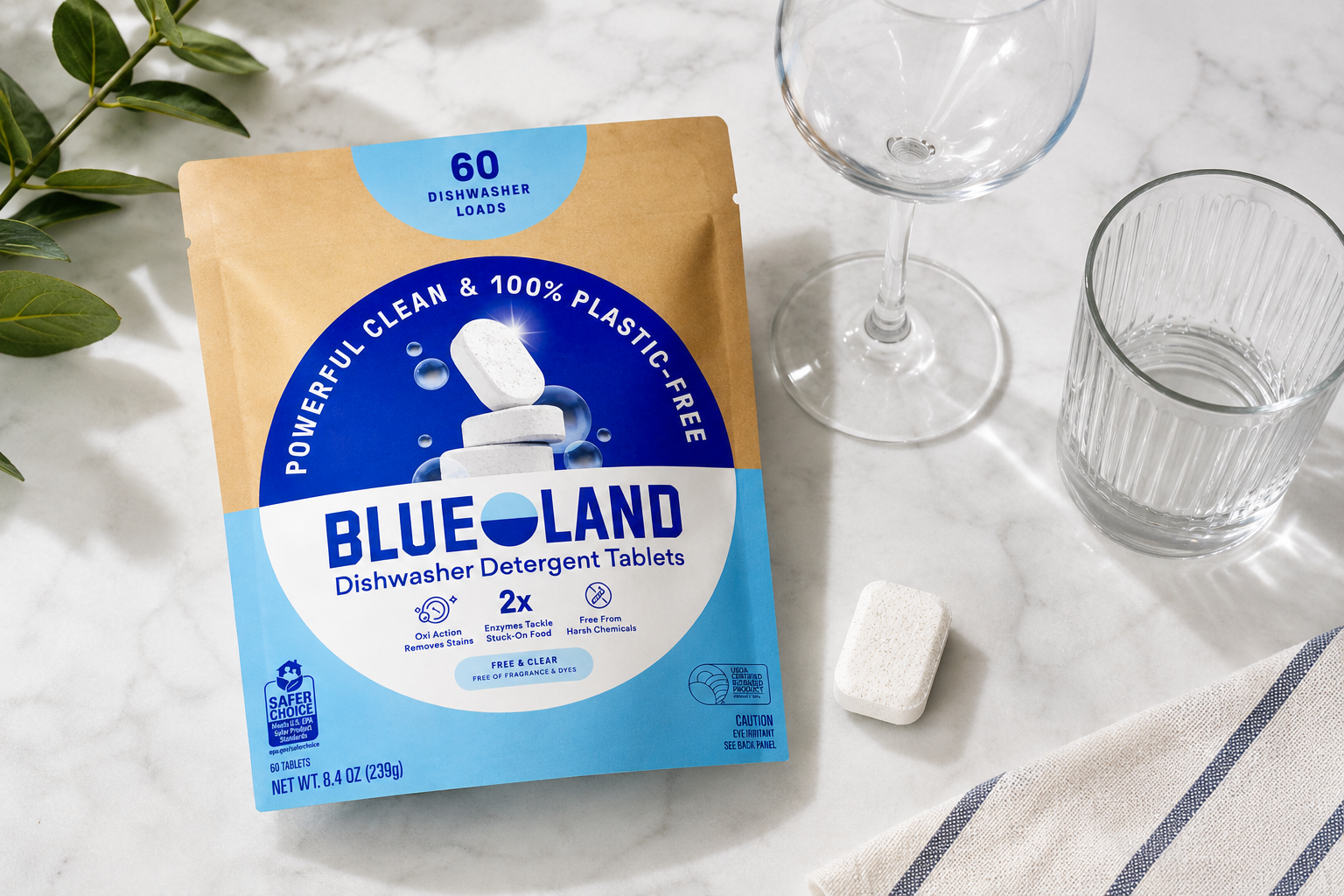
An honest, hands-on review of Blueland’s plastic-free dishwasher tablets after months of daily use, including hard-water results, the real cost per load, and the best way to buy them.
Heads up: some links below are affiliate links. If you buy through them, Eco-Economy Insider may earn a small commission at no extra cost to you. I bought and use this product myself, and being an affiliate does not change my honest opinion or my recommendation. Full disclosure is at the bottom.
Table of Contents
Quick verdict: After several months of running Blueland dishwasher tablets in a hard-water home, the short answer is yes, they are worth it. Our dishes come out cleaner than they did with our old pod-plus-rinse-aid routine, and we no longer buy a separate rinse aid because Blueland builds one into the tablet. And these tablets are truly 100 percent plastic-free, with no film, no wrapper, and no plastic of any kind, so they contribute zero microplastics to your wash water. If you want a plastic-free dishwasher detergent that genuinely works, this is one of the easiest swaps to recommend.
See current scents, sizes, and bundle pricing on Blueland’s site: Check the latest on the Blueland dishwasher tablets here.

Most people meet this product the same way we did: standing in a Costco aisle, holding a tan paper bag of dishwasher tablets, wondering whether the plastic-free version actually cleans as well as the pods they have used for years. That is the question this review answers, with real results and real numbers, because a dishwasher tablet is a small repeated purchase, and small repeated purchases are where both your budget and your plastic footprint quietly add up.
Our family switched to Blueland tablets several months ago, and what follows is an independent review of how that has gone. It is also the newest addition to my list of vetted sustainable swaps.
What are Blueland dishwasher tablets?
Blueland’s dishwasher product is a dry, compressed, plastic-free tablet. You drop one into the dispenser and run a normal cycle. There is no plastic film to peel and no liquid to pour, and nothing is wrapped around the tablet at all.
The fragrance-free version uses a short list of recognizable ingredients: sodium carbonate and citric acid as the cleaning and water-softening base, two enzymes (subtilisin and amylase) to break down proteins and starches, plant-derived surfactants, and hydrated silica. The reformulated tablet also includes a built-in rinse aid and an oxygen-based stain fighter for coffee, tea, and wine. It is USDA Certified Biobased, septic-safe, rated for high-efficiency machines, and tested for hard water. The company holds EPA Safer Choice, Cradle to Cradle, Leaping Bunny, B Corp, and Climate Neutral certifications, and the tablets are made in the USA.

Blueland itself launched on Earth Day 2019, founded by Sarah Paiji Yoo and Syed Naqvi, and became widely known after a Shark Tank appearance. The company’s whole reason for existing is removing single-use plastic from everyday cleaning, and this tablet is that mission in its purest form.
There is one more credential worth calling out, because it speaks directly to what is in the formula rather than what is left out. The fragrance-free tablets are EWG VERIFIED, a mark the Environmental Working Group gives only to products that contain none of the ingredients on its running chemicals-of-concern list and that meet its standards for disclosure and safety. This is not a blanket Blueland badge. EWG verifies the fragrance-free dishwasher tablets and the free and clear laundry tablets specifically, which happens to be the exact version this review is about.
I spent years at EWG, so I know their ecolabel is legit, and I read it as a meaningful third-party check that the short ingredient list on the box really is as clean as it looks. Paired with the EPA Safer Choice and Cradle to Cradle certifications, it means three independent programs, each looking at a different question, have signed off on what goes into these tablets.
Do Blueland dishwasher tablets actually work?
In our home, the answer is a clear yes. Glassware comes out clearer, with far less of the cloudy film we used to fight, even though our water is on the harder side. We are not alone in that. Across retailer reviews you will find owners of LG, Bosch, and other machines reporting clean dishes with no residue, which is the most common worry people have before they switch.
Two honest mechanisms explain our better results, and neither is magic. First, the tablet has a rinse aid built in, and we were not always consistent about keeping our old separate rinse aid topped up. Second, the enzymes do their best work when you skip the heavy pre-rinse and let them have some food residue to actually break down. So part of the improvement is the product, and part is that the product nudged us into better dishwasher habits: scrape, do not rinse, and let the enzymes work. If you are comparing fairly against your current detergent, that is worth knowing.
A practical note for the skeptics. If your first load looks spotty, check that your water is hard (these are designed for it) and stop pre-rinsing so thoroughly. The enzymes need something to grab onto.
100 percent plastic-free: zero plastic, zero microplastics
This is the heart of what makes these tablets different, and on this point there is no asterisk and no fine print. The Blueland tablet contains no plastic, period. No plastic film, no dissolvable wrapper, no synthetic polymer coating, nothing. It is a bare, compressed tablet of minerals, enzymes, and plant-derived cleaning agents that dissolves completely in the wash. Because there is no plastic in the product, there is no plastic going down your drain. Zero in means zero out. These tablets contribute no microplastics to your wash water, your pipes, or the waterways beyond them.
That is rarer than you might think. Nearly every conventional dishwasher pod on the shelf is individually sealed in a thin dissolvable film made from a synthetic polymer called polyvinyl alcohol, written as PVA or PVOH. Blueland engineered the film out entirely, which is why the company calls these one of the only “naked” dishwasher tablets on the market. The tablet’s form was specifically designed to survive shipping without a wrapper and still dissolve fully in the machine.
For our family, this is the appeal in one sentence: when every ingredient is a mineral, an enzyme, or a plant-derived cleaner, there is simply no plastic question to ask. You do not have to parse polymer chemistry or wastewater studies to know what is in your water, because you can read the whole ingredient list and understand every line. If you have been looking for a dishwasher detergent with no plastic and no PVA at all, this is exactly that.
Do you need rinse aid with Blueland tablets?
No, and this was the surprise saving for our family. The tablet includes a rinse aid ingredient, so you do not add a separate one. We used to buy Finish Jet-Dry. We have not bought it since switching, and our glasses are actually clearer than before.
I want to be specific rather than flattering about the dollars, because honesty is the point of this blog. A large bottle of Jet-Dry covers a few hundred loads for roughly eight to ten dollars, so on a per-load basis rinse aid was only costing us a couple of cents. The dollar savings there are modest, maybe five to ten dollars a year for a typical family. The bigger wins are that it is one fewer product to track and rebuy, and one fewer plastic bottle moving through the house every year or so. If you hate clutter and extra shopping-list items, that convenience is real.
What is the best way to buy Blueland dishwasher tablets?
Here is the most useful money advice in this review, and I am going to give it to you straight even though I am an affiliate.
If you have a Costco membership, the warehouse club has consistently been the cheapest place to buy the plain tablets in bulk, often well below the price on Blueland’s own website. If your only goal is the lowest possible price per load on the fragrance-free tablets, that is the move, and I would rather tell you that than pretend otherwise.
That said, Costco only stocks one or two Blueland items, and a lot of readers have good reasons to buy direct instead:
- You do not have a Costco membership, or you would rather have it shipped to your door.
- You want the Lemon Zest scent, a smaller starter size to try first, or a format Costco does not carry.
- You want to set it on autoship, which takes 20 percent off and narrows the price gap considerably.
- You want to replace more than just dishwasher detergent (more on that below), and bundling is cheaper than buying piecemeal.
If any of those fit you, buying from Blueland is the sensible call. See the current price, scents, and sizes here: shop the Blueland dishwasher tablets, or start an autoship for 20 percent off if you want it on a schedule.
For context on value, premium pods are not cheap either. At typical retail, Cascade Platinum pods run around 32 cents a load, Cascade Platinum ActionPacs closer to 46 cents, and Finish Quantum around 33 cents, and those routines usually need a separate rinse aid on top. A plastic-free tablet with the rinse aid already built in is competitive with the premium pod it replaces, however you buy it.
What about the packaging?
The refills come in paper packaging that Blueland describes as industrially compostable. That is a real improvement over a rigid plastic tub. But I want to be precise, because the word compostable does a lot of marketing work. Industrially compostable is not the same as backyard compostable or curbside green-bin compostable. It breaks down in a commercial facility under controlled heat, and most American households do not have access to one that accepts this material. If the packaging ends up in your regular trash, it is paper headed to a landfill rather than plastic, which is still better, but it is not the closed loop the word implies. Treat the packaging win as “paper instead of plastic,” which is genuinely good, rather than as magic.
There is also a quiet lifecycle advantage worth naming. A liquid or gel detergent is mostly water, and a pod adds molded plastic packaging. A dry tablet is neither, so you are not paying to ship water or plastic across the country. Less weight and volume per wash means lower freight emissions per wash, the kind of unglamorous detail that adds up far more than any single bullet on the box.
Blueland vs Cascade and conventional pods
| Feature | Blueland tablet | Typical premium pod (Cascade, Finish) |
|---|---|---|
| Plastic in the product | None, 100 percent plastic-free | Sealed in PVA film |
| Rinse aid | Built in | Buy separately |
| Hard water | Formulated for it | Varies |
| Dyes and fragrance | None (free and clear option) | Usually present |
| Packaging | Paper | Rigid plastic tub |
| Cost per load (typical) | Competitive, and lowest in bulk | About 32 to 46 cents, plus rinse aid |
The honest summary: conventional premium pods are not bad cleaners, and several have cleaned up their formulas over the years. The phosphate worry, for example, is largely settled across the whole category and is no longer a real point of difference. What Blueland changes is simple and absolute: no plastic in the product at all, no second rinse-aid product to buy, and paper instead of a plastic tub.
Who should buy these (and who should not)
Buy them if you want a 100 percent plastic-free, non-toxic dishwasher detergent that actually cleans, you have hard water or fight spotty glasses, and you are tired of buying rinse aid separately. That covers most households asking whether the switch is worth it. Take a look at the current options here.
Think twice if you were hoping the packaging would go straight into your backyard compost, which it will not for most people. Set that expectation correctly and you will be happy.


Go further: the rest of the plastic-free line
If the dishwasher tablets win you over, the easiest next step is to replace the other single-use plastic in your cleaning routine. This is where buying direct genuinely pays off, because Blueland sells its whole line and bundles it at a discount, while a warehouse club only carries a couple of items.
The lineup includes plastic-free laundry tablets, hand soap, multi-surface and bathroom sprays, toilet cleaner, and dish soap. If you want to swap several at once, the Build a Bundle option takes up to 35 percent off, which is both cheaper and a bigger dent in your household plastic than any single product. For most families, a starter bundle plus autoship is the simplest way to go plastic-free across the kitchen and bath in one step.
The bigger picture
There is a reason a small swap like this is worth writing about. The case for choosing the better product is not heroic personal carbon math. The real argument is the aggregate market signal. Demand for the better option is what builds the supply chain, the domestic manufacturing, and the jobs behind it, and it is what pulls a whole product category toward less plastic. It is the household-scale version of the case I have made for protecting nature as the smartest investment on Earth: a better choice for nature that also makes economic sense is exactly how a market moves, one ordinary purchase at a time.
Blueland dishwasher tablets FAQ
Are Blueland dishwasher tablets really plastic-free? Yes, completely. The tablet contains no plastic film, no PVA or PVOH wrapper, and no plastic of any kind. It is a bare tablet of minerals, enzymes, and plant-derived ingredients, so it contributes zero microplastics to your wash water.
Are Blueland dishwasher tablets safe for families? The formula is free of dyes, synthetic fragrance, phosphates, chlorine bleach, parabens, and phthalates, and it carries EPA Safer Choice certification. Like any dishwasher detergent, it should be used as directed and kept away from children.
Do Blueland tablets work in hard water? Yes. They are mineral-based and specifically formulated to fight spotting and filming in hard water. In our hard-water home, glassware comes out clearer than it did with our previous routine.
Do they work in HE, Bosch, or LG dishwashers? Yes. The tablets are formulated for high-efficiency machines, and owners of a range of dishwashers, including LG and Bosch, report clean, residue-free results.
Do I need a separate rinse aid? No. The tablet has a rinse aid ingredient built in, so you can stop buying a separate product like Jet-Dry.
Are Blueland dishwasher tablets septic-safe? Yes, the formula is septic-safe.
Where is the best place to buy Blueland dishwasher tablets? For the lowest price on the plain tablets in bulk, a Costco membership is hard to beat. If you do not have one, want a specific scent or size, prefer door delivery, or want to bundle several products, buying direct from Blueland is the better option, and autoship takes 20 percent off.
Do Blueland tablets come scented? You can choose fragrance-free (free and clear) or Lemon Zest.
Will they leave a film or residue? In our experience the opposite, but if you see spotting, stop heavily pre-rinsing your dishes. The enzymes need some food residue to work on, and over-rinsing can leave glasses cloudy with any enzyme detergent.
Ready to make the swap? See current scents, sizes, and bundle pricing on Blueland’s site. If you are working through easy, no-regret sustainable swaps, this is one of the better ones to start with, and you can find the rest in my eco-buying swaps guide.
Disclosure: this post contains affiliate links. Read the full policy here. All products were selected based on independent research — no brand paid for a mention.
Get the next swap before it’s public
I send new vetted swaps, the economics behind them, and the occasional warning about a product that did not earn its hype. No spam, I never sell your address, and you can unsubscribe anytime.


Leave a Reply