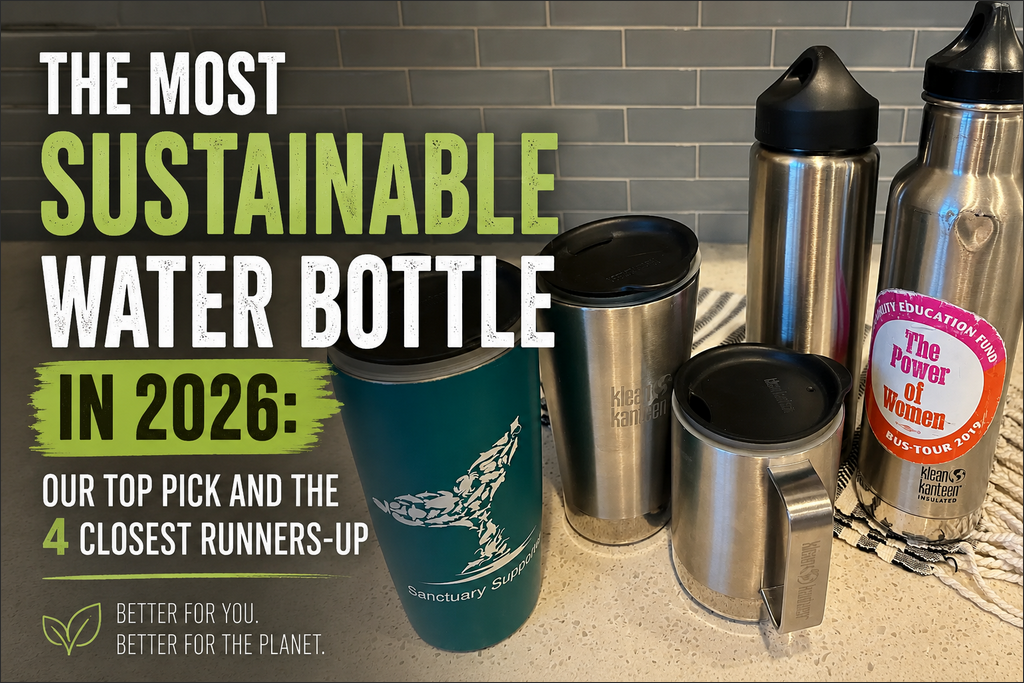
After scoring the top bottles on lifecycle carbon, durability, and verified proof, the most sustainable water bottle is a clear winner.
Quick note: some links below are affiliate links. If you buy through them, Eco-Economy Insider may earn a small commission at no extra cost to you. We only point you toward gear we actually use and would buy again, and our family has carried our top pick for years.
Table of Contents
If you want the short version, our pick for the most sustainable water bottle is Klean Kanteen. The next four, MiiR, 24Bottles, Nalgene Sustain, and Hydro Flask, are all genuinely good, and we will tell you exactly where each one shines and where it falls short.
But “most sustainable” is a claim worth checking into more closely, because the reusable water bottle is the easiest fake environmental win on the shelf. Buy one, skip the plastic, feel good. The real math is more interesting, and once you understand it, the right bottle picks itself.
How we ranked them (and why it is not what most reviews measure)
Here is the fact that reorders everything. Most of a bottle’s environmental cost is paid up front, in mining and manufacturing, before you ever fill it. Across published life cycle assessments, production accounts for the large majority of a reusable bottle’s carbon footprint. Washing it and recycling it later are rounding errors by comparison.
That means a bottle is not “green” the day you buy it. It is a carbon debt you pay down a little with every refill instead of buying plastic. How fast you break even depends almost entirely on the material: a single-wall steel or durable plastic bottle pays itself back in roughly 10 to 30 uses, an insulated double-wall steel bottle in about 30 to 90 uses, and an aluminum bottle takes far longer because making aluminum can produce something like 100 times the emissions of one throwaway plastic bottle. The flip side is the trap: a bottle you use twice and abandon is worse than the plastic it replaced.
So three things decide whether a bottle earns the “sustainable” label, and we ranked on all three:
- What it is made of, including recycled content. This is the heaviest part of the footprint, so recycled steel beats virgin steel by a wide margin.
- How long it lasts. Durability, repairability, and warranty are the real climate levers, because every extra year of use spreads that upfront cost thinner.
- Proof, not promises. Anyone can stamp “eco” on a box. We weighted independent, audited credentials (B Corp scores, Climate Neutral certification, science-based targets) far above anything a brand says about itself.
We also gave credit for the parts of the lifecycle buyers rarely check: lead-free construction, clean coatings, and what actually happens to the bottle at the end of its life.
The top 5 at a glance
| Rank | Bottle | Best for | Material (recycled content) | Standout verified credential | Lead-free |
|---|---|---|---|---|---|
| 1 | Klean Kanteen | Best overall on climate and materials | Steel (90% recycled) | B Corp 110.9 + Climate Neutral | Yes (silica plug) |
| 2 | MiiR | Best for closing the loop | Steel (90% recycled) | B Corp 95.5 + mail-back recycling | Yes |
| 3 | 24Bottles | Best verified carbon transparency | Steel (virgin) | B Corp 90.4 + CarbonNeutral (ISO 14067) | Yes |
| 4 | Nalgene Sustain | Lowest footprint to manufacture | Tritan (50% recycled) | ISCC-certified, made in USA | No vacuum seal |
| 5 | Hydro Flask | Best availability and color range | Steel (virgin) | Science-based climate targets | Yes |
Now the detail, starting with the winner.
1. Klean Kanteen: the most sustainable water bottle, full stop
Best for: almost everyone, and the clear leader on climate, materials, and proof.
Klean Kanteen wins because it attacks the heaviest part of the footprint head-on. Its bottles are built from certified 90 percent post-consumer recycled stainless steel, while almost every premium competitor, Hydro Flask, Yeti, Stanley, uses virgin steel mined and smelted from scratch. By the company’s own lifecycle accounting, switching from virgin to recycled steel cut the greenhouse gas emissions of its steel by about 40 percent, dropped energy demand by about 30 percent, and reduced ecosystem impacts by 60 to 80 percent. That is the single biggest lever in this entire category, and Klean Kanteen is the brand pulling it.
The proof behind the marketing is just as strong. Klean Kanteen is a certified B Corporation, the third-party standard audited by the nonprofit B Lab, with an overall score of 110.9 against a median of about 51 for ordinary businesses and a passing bar of 80. That is the highest score of any bottle brand we found. It has been Climate Neutral certified since 2020 (now carrying the Climate Label), and a member of 1% for the Planet since 2008, directing more than 4 million dollars to environmental groups. It is family- and employee-owned, which keeps its mission insulated from outside shareholder pressure.
On safety, it is a standout. While many insulated bottles are sealed at the base with a small lead pellet (the issue behind the 2024 tumbler headlines), Klean Kanteen seals its bottles with silica or glass plugs instead, a more expensive, fully lead-free choice it makes on purpose. Its bottles are BPA-free, and its colored finish, Klean Coat, was developed using a chemical-screening process to keep substances of concern out of the coating.
And then there is the lever that quietly beats everything: longevity. Klean Kanteen backs its bottles with a lifetime warranty against manufacturing defects, and it sells replacement caps, gaskets, and lids. A bottle you can repair is a bottle you do not replace, which is the most sustainable, and the most economical, outcome of all. Spread a 40 or 50 dollar bottle across ten or fifteen years of daily use and the cost per use rounds to nothing, while the case of plastic you skip adds up to real money.
The honest caveat: insulated models cost more than a basic bottle, and the double-wall versions carry the higher break-even we mentioned. If you do not need insulation, the single-wall Classic is the lightest, cheapest, lowest-footprint option in the whole roundup.
Which Klean Kanteen should you buy?
Here is how we’d choose, in plain order of who each one is for. These are the lines our family actually reaches for.
- One bottle that does everything: the TKWide (insulated). Climate Lock vacuum insulation keeps water cold for well over a day and coffee hot for hours, and the wide mouth takes interchangeable caps, so the same bottle handles water, smoothies, and the road-trip coffee. If you buy one thing from this post, make it this. See current TKWide prices and colors →
- Plain water and the lowest footprint: the Classic (single-wall). Less metal, a faster break-even, a lighter carry, a lower price, and no plastic in the drink path. See the Classic lineup →
- Coffee and tea people: an insulated tumbler or mug. The part of our cupboard we use most, and the easiest single-use cup to retire. Browse tumblers and mugs →
All three use the same 90 percent recycled steel, the same lead-free build, and the same lifetime warranty, so you are not trading down on values to pick the one that fits your routine.
Shop the full Klean Kanteen range →
2. MiiR: best for closing the loop
Best for: buyers who want their bottle recycled for real at the end, not just “recyclable” in theory.
MiiR is the closest challenger, and on one dimension it edges ahead. It matches Klean Kanteen’s core credentials almost point for point: a verified B Corp score of 95.5, the Climate Label (an independently verified footprint with cradle-to-customer emission cuts), 1% for the Planet membership, and bottles built from 90 percent recycled stainless steel. It is lead-free and lifetime-warrantied.
Its differentiator is Re:Claimed, a take-back program: you ship worn-out MiiR gear back with a prepaid label and it gets recycled. That directly fixes the dirty secret of steel bottles, that they are endlessly recyclable on paper but almost never accepted curbside. Every MiiR product also carries a Give Code that traces the exact giving project it funded.
The honest caveat: its B Corp score sits just below Klean Kanteen’s, and its lightest line leans partly on carbon offsets to reach neutrality, which is a weaker climate tool than cutting emissions at the source.
3. 24Bottles: best for verified carbon transparency
Best for: anyone who wants third-party-audited carbon numbers rather than vague “carbon neutral” claims.
If documented carbon accounting is your priority, 24Bottles is the most transparent brand here. The Italian maker is a certified B Corp with a 90.4 score, and it did not stop at self-declaration: it had its footprint measured independently by TÜV Rheinland, its products are CarbonNeutral certified, and its manufacturing partners hold ISO 14067 (product carbon footprint) certification along with ISO 9001 and 14001. Its bottles are also deliberately lightweight, which trims both production and shipping impact.
The honest caveat: 24Bottles uses virgin steel rather than recycled, it manufactures in China (longer transport to the US), and it reaches “carbon neutral” largely through offsets instead of absolute cuts. We rank its transparency at the top and its raw material footprint a notch behind the recycled-steel leaders.
4. Nalgene Sustain: lowest footprint to make, and nearly indestructible
Best for: budget-minded buyers, gym and trail use, and anyone who wants the smallest manufacturing footprint of the bunch.
This is the dark horse, and on pure cradle-to-grave carbon it is hard to beat. A durable plastic bottle takes far less energy to make than any steel or aluminum bottle, so it breaks even fastest, and Nalgene improves on that further. The Sustain line is made from material derived from 50 percent plastic waste using ISCC-certified traceability (Eastman’s Tritan Renew), it is made in the USA (which cuts transport emissions), and the famous Nalgene toughness means it lasts for decades. It is BPA- and BPS-free and dishwasher safe.
The honest caveat: it is plastic, so it cannot match steel or glass on microplastics. Reusable plastic sheds far less than single-use, but it is not zero, especially as a bottle ages and develops micro-wear. It is also single-wall (no insulation), and Nalgene holds no B Corp or climate certification at the company level. The “50 percent recycled” figure is a certified mass-balance accounting method, so a given bottle is not guaranteed to be physically half-recycled.
5. Hydro Flask: best availability, and great if you already own one
Best for: shoppers who want a proven insulated bottle they can buy anywhere, in any color.
Hydro Flask is the strongest of the big-volume brands, and we are happy users. We picked up several for free, passed along by another family that had quietly bought more bottles than four people could ever drink from (hold that thought, it matters in a second). They are excellent: durable, lead-free (Hydro Flask removed lead from its sealing process more than a decade ago with its TempShield insulation), and lifetime-warrantied. Its parent company has set science-based emissions targets, moved to FSC-certified recycled packaging, and helped found an industry climate coalition.
The honest caveat: the bottle itself is virgin steel (the recycled content is in the packaging, not the vessel), it is not a certified B Corp, and it is owned by a publicly traded conglomerate, so its mission answers to shareholders in a way the employee-owned leaders do not. For a brand-new purchase, that is what drops it behind Klean Kanteen and MiiR. If you already own one, though, the greenest move is simply to keep using it.
The hidden factor that beats every brand: do not buy five
Back to that family giving away Hydro Flasks. They are the cautionary tale for this entire category. A reusable bottle only beats single-use if you do not collect them like trading cards. Every new bottle carries that heavy upfront footprint, so buying your fifth one in a trendy color can erase the savings of the first four.
This is the part the industry would rather you not internalize, and it is the most important sentence in this post: the most sustainable water bottle is the one you already own. If you have a good bottle, keep it. It’s the same buy-it-once logic we used on our dishwasher tablet pick. If you are buying, buy one built to be your last, repair it when a cap wears out, and use it for a decade. That is the whole strategy, and it is the same logic that makes any well-made reusable a smart-money purchase rather than a guilt purchase.
How to choose in 30 seconds
- Want the best all-around climate and materials choice, made to last? Klean Kanteen TKWide.
- Want the lowest price and lowest manufacturing footprint? Nalgene Sustain, or the Klean Kanteen Classic.
- Want a mail-back recycling guarantee? MiiR.
- Want audited carbon numbers? 24Bottles.
- Already own a decent bottle? Keep it. Then upgrade to one of the above only when it truly wears out.
For most people, most of the time, the answer is the top pick. It leads on the heaviest part of the footprint, it has the receipts to prove it, and it is built to be the last bottle you buy.
See current Klean Kanteen prices and colors →
Want more swaps that pay for themselves? Eco-Economy Insider sends one practical, fact-checked idea at a time, no guilt, no fluff. Join the newsletter here.
Frequently asked questions
What is the most sustainable water bottle? Klean Kanteen, on the measures that matter most. It uses 90 percent recycled stainless steel (which cuts the heaviest part of the footprint by 40 to 80 percent versus virgin steel), holds the highest B Corp score in the category at 110.9, is Climate Neutral certified, and is built to last a lifetime with a warranty and replaceable parts.
Are stainless steel water bottles better for the environment than plastic? Yes, as long as you use them for a while. A steel bottle takes more energy to make than a single-use plastic one, so it needs roughly 10 to 90 uses to come out ahead depending on whether it is insulated. Daily use clears that in weeks to a few months, and steel also avoids shedding microplastics into your water.
Is Klean Kanteen better than Hydro Flask? For a new purchase, yes, on sustainability. Both are durable, lead-free, and lifetime-warrantied, but Klean Kanteen uses recycled steel instead of virgin steel and holds a top-tier B Corp certification, while Hydro Flask does neither. If you already own a Hydro Flask, the most sustainable choice is to keep using it.
Which water bottle brands are certified B Corporations? Among the bottles we ranked, Klean Kanteen (110.9), MiiR (95.5), and 24Bottles (90.4) are certified B Corps. Hydro Flask, Yeti, and Stanley are not.
Are reusable water bottles actually worth the money? Over a decade of daily use, a 40 to 50 dollar bottle costs almost nothing per use and replaces hundreds of single-use bottles a year. With a lifetime warranty, buying one good bottle is cheaper than slowly collecting several.
Are Klean Kanteen bottles lead-free? Yes. Klean Kanteen seals its insulated bottles with silica or glass plugs rather than the soldered lead some brands use, and its bottles are BPA-free with a chemical-screened finish.
Sources and further reading
- B Lab, B Impact Assessment scores: Klean Kanteen — 110.9 · MiiR — 95.5 · 24Bottles — 90.4
- Klean Kanteen’s certified recycled stainless steel announcement (40% lower steel emissions, 60–80% lower ecosystem impact): BusinessWire release
- 1% for the Planet and the Climate Label: Klean Kanteen on 1% for the Planet · Klean Kanteen on The Climate Label
- Life cycle assessment reviews of reusable vs. single-use bottles (break-even by material): UN Environment Programme report (2020) · NORSUS review of reuse-system LCAs · Peer-reviewed refill-and-reuse LCA (ScienceDirect)
- 2024 study on nanoplastics in bottled water (~240,000 particles per liter): Columbia University summary · PNAS paper (PubMed) · AP via PBS NewsHour
- Lead in insulated tumbler bases (2024 reporting and CT-scan analysis): PolitiFact fact-check · Gizmodo CT scan (Lumafield) · NBC News expert analysis
- Lead-free sealing (silica/glass plugs): Tasting Table · Toxic Free Choice


Leave a Reply