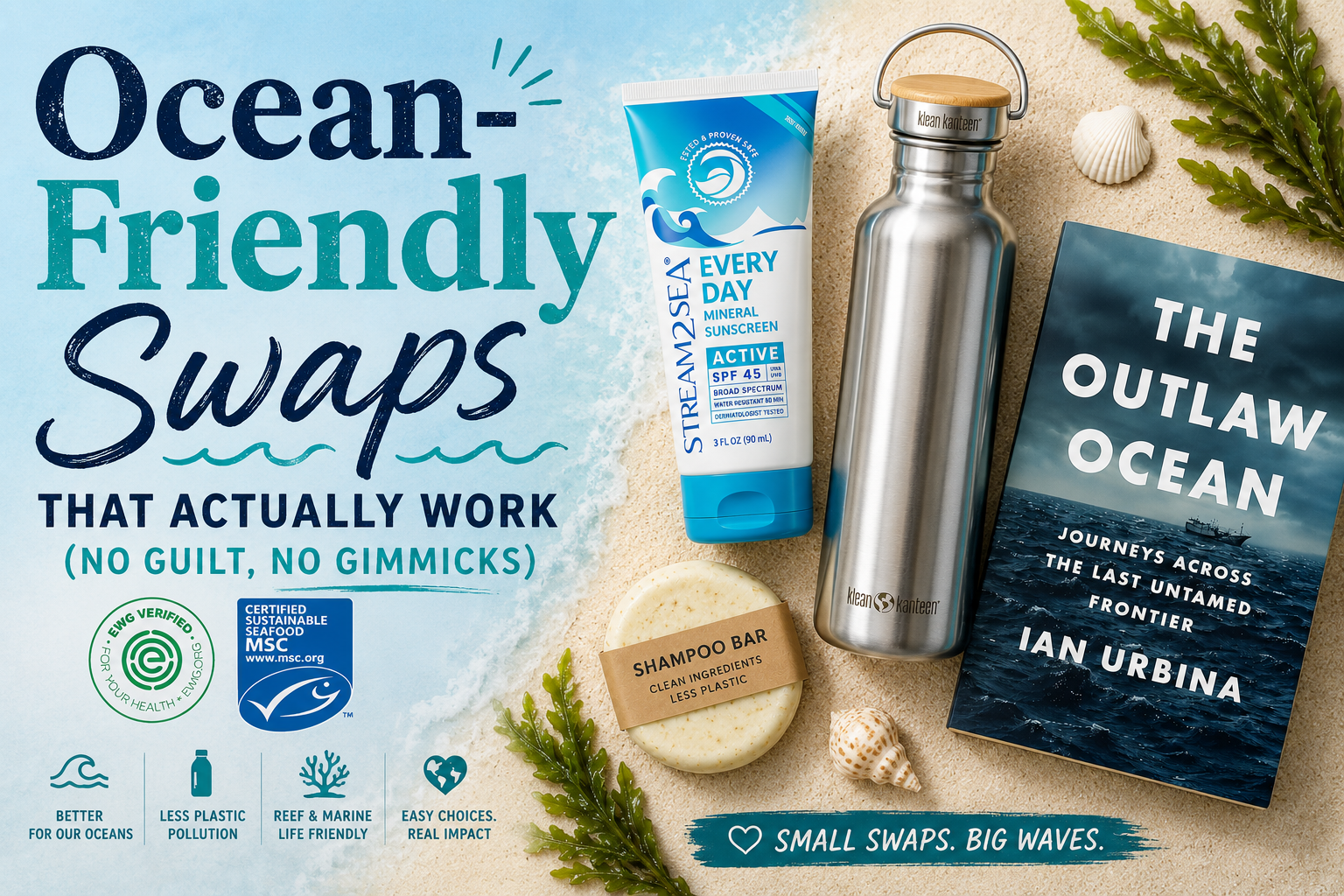
Here’s the rule I bring to anything ocean-related — one I’ve carried through a career on ocean and consumer-health work, at NOAA’s Coral Reef Conservation Program, the Marine Stewardship Council, and the Environmental Working Group: I ask two questions at once, Is it safe for me? and Is it safe for the ocean? The first isn’t an afterthought for me; it’s half the test. The good news is that for most of the ocean-friendly swaps below, the answer to both is the same product — so nothing here asks you to give anything up. Let’s start with the one where that’s truest.
This post contains affiliate links. If you buy something through one of them, I earn a small commission at no extra cost to you. As always: before buying anything new, consider whether you already own something that works, or whether you can find it secondhand. When a purchase does make sense, I only link to things I’d actually recommend. Full disclosure policy here.
Table of Contents
Five Ocean-Friendly Swaps Worth Making
1. Reef-safe mineral sunscreen: Stream2Sea
Sunscreen is one I get asked about a lot, so it gets its own guide.
More in my Reef-Safe Sunscreen and Coral Reefs guide →
2. Shades that clean up the ocean’s worst plastic
Why it matters: the most dangerous plastic in the sea isn’t straws — it’s “ghost gear,” the lost and discarded fishing nets that keep trapping marine life for decades. An estimated 640,000 tons of it enters the water every year. It’s also, notably, a fishing problem — which sets up the next swap.
The pick — Costa “Untangled” sunglasses, made with Bureo’s NetPlus. Costa and the ocean-materials company Bureo take discarded fishing nets collected from commercial ports in Chile and turn them into sunglass frames — built from 97–100% recycled fishing nets, with a fully traceable supply chain. Bureo’s net-collection program also supports the coastal fishing communities doing the work.
The honest take: a pair of sunglasses doesn’t “cancel out” ocean plastic, and I’d never pitch it that way. But if you were going to buy shades anyway, buy the pair that pulls nets out of the water and pays fishers to retrieve them. That’s the whole win.

3. Sustainable seafood — because “Sustainable Fishing Means More”
If the ghost-gear story shows the fishing industry’s worst side, this is the swap that rewards its best — and it’s the heart of this year’s seafood-world push, the Marine Stewardship Council’s “Sustainable Fishing Means More” campaign. (Full disclosure, and full enthusiasm: I worked at the Marine Stewardship Council — so I know the blue fish from the inside.)
The framing is exactly the optimistic, economic one I love: sustainable fishing means more nutritious meals, more for local economies, more life and color in the ocean, and more wonders left to discover. And it means more fish — the MSC notes that sustainable practices could ultimately put 16 million more tonnes of seafood on the world’s plates each year. You don’t have to give up seafood to protect the ocean. You have to choose it well.
How to actually do it:
- Look for the blue fish tick. The MSC blue fish label turns up on tinned tuna, salmon, frozen fish, prawns — even pet food. It means the fishery met three standards: healthy fish stocks, low environmental impact, and effective management. When you see it, that’s the easy yes.
- Lean into seafood as a climate-smart protein. The Blue Food Assessment found that producing aquatic foods is generally less environmentally harmful than most land-based animal proteins — so a well-sourced fillet is often the lower-footprint dinner. (Nature creates jobs and dinner.)
- When there’s no label, ask, and cross-check. Bookmark the free Monterey Bay Aquarium Seafood Watch guide — a tool I have enormous respect for — and check it before you order. → seafoodwatch.org
The honest take: no eco-label is perfect, but I treat the MSC blue fish tick as the gold standard and for anything not labeled, I cross-check with Seafood Watch. “Trust, but verify” is the EWG in me again.
4. The painless plastic-free swaps
Plastic flowing into the ocean is on track to nearly triple by 2040, and most of it starts on land — in throwaway everyday items. These are the quiet wins that cut that flow without a second thought once you make them:
A solid shampoo + conditioner bar (outlasts 2–3 bottles, sails through airport security).

A reusable water bottle you’ll actually carry.

A microfiber-catching laundry bag or ball
Every wash of synthetic clothing sheds tiny plastic fibers that flow to the ocean and into the food chain. A microfiber-catching wash bag, such as a Guppyfriend, or an in-drum catcher, like a Cora Ball, traps those fibers before they leave your machine. It is a small, one-time purchase that quietly prevents a lot of pollution.
Honest take: don’t throw out things that still work just to buy “eco” versions — that’s its own waste. Replace as you run out.
5. Read something that makes you smarter about the sea
Build an ocean reading list through Bookshop.org — every purchase supports independent bookstores instead of you-know-who, and it’s the rare affiliate option that feels fully on-brand.

The point of World Ocean Day isn’t to feel bad about the ocean — it’s to reimagine our relationship with it. Sometimes that means policy and protected areas (I made the case for why that’s the smartest investment on Earth in a separate piece). And sometimes it just means a bottle of sunscreen that’s good for your skin and the reef, a pair of shades that pulls nets out of the water, and a fillet with a little blue label.
Good choices don’t require sacrifice — and the best ones protect you and the ocean at the same time. Pick one ocean-friendly swap off this list and start there.
Disclosure: this post contains affiliate links. Read the full policy here. All products were selected based on independent research — no brand paid for a mention.
Get the next swap before it’s public
I send new vetted swaps, the economics behind them, and the occasional warning about a product that did not earn its hype. No spam, I never sell your address, and you can unsubscribe anytime.


Leave a Reply