When we talk about solar economics, we usually assume you own a roof. But roughly 36% of American households (myself included) rent. For us, the solar revolution has largely been a spectator sport.
That may be about to change.
Plug-in solar (small, modular systems that connect to a standard 120-volt household outlet) has quietly been building critical mass in Europe for a decade, with Germany alone estimated to have around 4 million installations. Now, a wave of state legislation is pushing the technology into serious U.S. policy discussion, with roughly 28 state legislatures currently considering bills to clarify or expand its use.
The economics are worth taking seriously.
What “Plug-In Solar” Actually Means
Plug-in solar (also called balcony solar, DIY solar, or plug-and-play solar) occupies a niche between the off-grid panels you’d put on a camping trailer and a full rooftop installation. A typical setup runs one to four panels (roughly 400 to 1,200 watts) mounted on a balcony railing, backyard shed, flat garage roof, or even a freestanding rack, and fed through a microinverter into a standard wall outlet.
No electrician required. No rewiring. No permit (in most places, though the regulatory picture varies, more on that below).
The key mechanism: electricity from the panels flows backward through the outlet and offsets whatever the household is consuming at that moment. It doesn’t charge a battery or feed the grid in any complicated way. It just reduces your draw from the utility, in real time.
Add a battery and you can store what you generate: here is how home battery storage pencils out in 2026.
The Experiment: $635, One Flat Garage Roof, and a Lesson in DIY Wiring
Earlier this year, Bentham Paulos (a Berkeley-based energy consultant working with the Clean Energy States Alliance and Berkeley Lab) published a detailed account in PV Magazine of building his own plug-in solar system from scratch. He’d been asked to write a policy brief on plug-in solar for state energy agencies, but felt he should understand the practice, not just the theory.
His bill of materials:
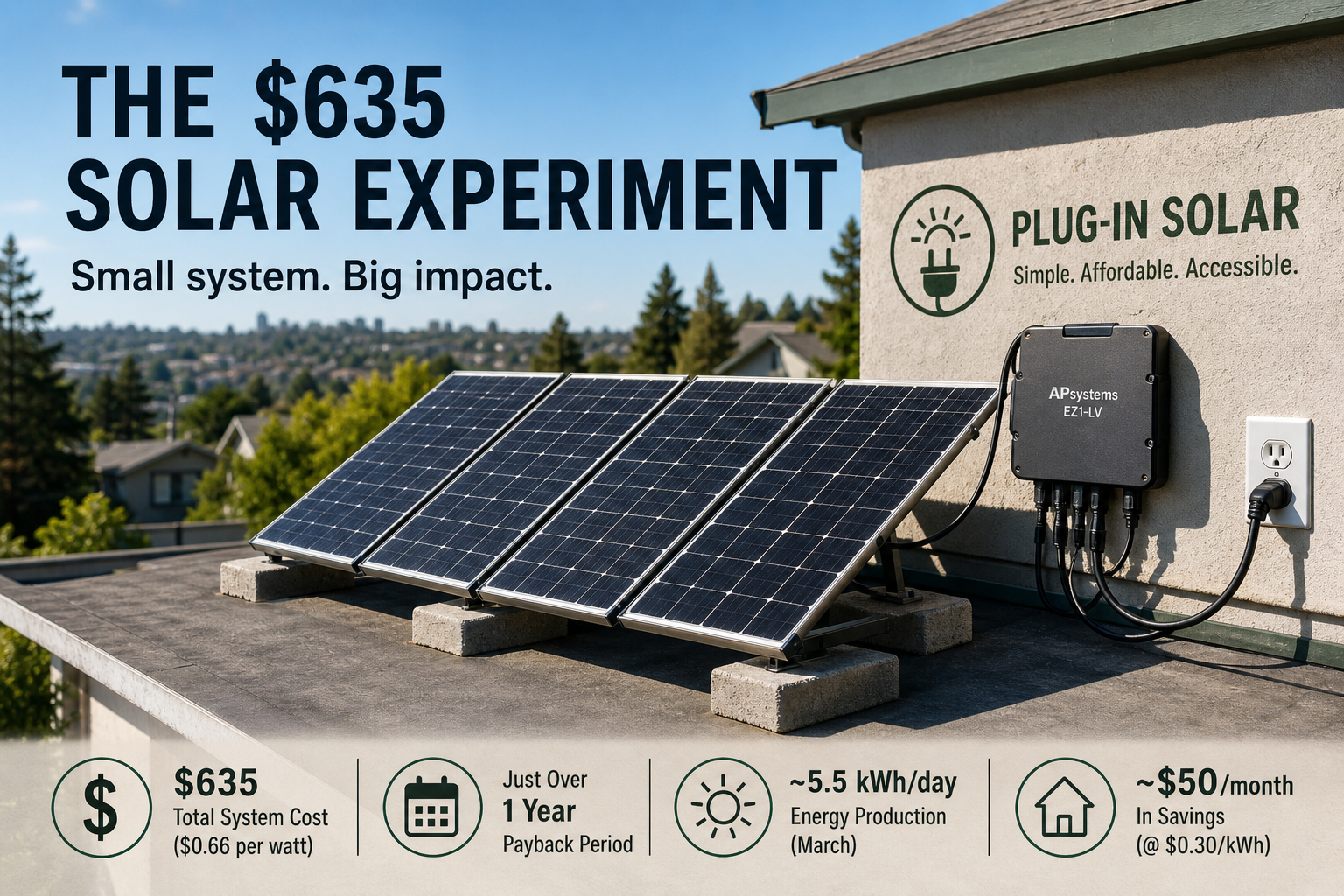
- Four used 315-watt panels from Facebook Marketplace in Richmond, CA — $200 total ($50 each)
- An AP Systems EZ1-LV microinverter — one of only two UL-certified 120V models available in the U.S. — $350
- Y-cables from Amazon — $60
- Concrete pier blocks from Home Depot for mounting — $25
Total system cost: $635 — or roughly $0.66 per watt of AC output. Payback period: just over one year.
That $0.66/watt figure is significant. It matches what IKEA’s solar partner, Svea Solar, charges in Germany for a complete two-panel kit — a price that reflects a mature, competitive market with many retailers and manufacturers. In the U.S. today, new commercial plug-in kits from companies like Brightsaver and EcoFlow run closer to $1.58–$1.60 per watt. Paulos hit the future price by going the used-parts route now.
Once installed on his flat garage roof, the system produces around 5.5 kWh per day in March. At California retail electricity rates near $0.30/kWh, that translates to roughly $50 per month in savings.
The Regulatory Knot (And Why It’s Starting to Loosen)
The reason plug-in solar hasn’t already taken over in the U.S. is mostly regulatory, not technical. The two central concerns are grid safety and billing.
On safety: Modern microinverters are already governed by UL 1741, which requires “anti-islanding” capability — meaning the system automatically shuts off if grid power drops, protecting utility line workers. A newer certification framework, UL 3700, is now available and designed specifically for plug-in systems. The safety problem is largely solved at the hardware level.
On billing: Most plug-in systems won’t qualify for net metering (the program that compensates homeowners for energy sent back to the grid) because the paperwork requirements would defeat the plug-and-play premise. Utah and Virginia have addressed this by simply exempting small systems from net metering requirements. That clears the legal path, but means any surplus electricity you generate essentially goes to the utility for free. For renters who rarely generate more than they use in real time, this is generally a non-issue.
For California homeowners who already have rooftop solar, there’s an interesting near-term opportunity worth knowing: under existing CPUC rules, current NEM customers can add up to 1 kW of additional capacity without new permitting or losing their NEM status. “NEM expansion kits” from companies like Brightsaver are specifically designed around this window.
The Economics
Plug-in solar isn’t going to replace a full rooftop installation for a homeowner with good sun exposure and a high electricity bill. Rooftop solar still delivers a better return at scale and remains the right call for most homeowners who qualify. It is part of why solar and storage dominated new U.S. capacity in 2024.
But that comparison misses the point for a large slice of the American energy economy. For renters, apartment dwellers, and homeowners who can’t or don’t want to navigate a full installation, plug-in solar offers something rooftop can’t: access. And at a payback period of 1–2 years, the economics compare favorably to nearly any other discretionary home upgrade. Renters can electrify other ways too, like installing a Level 2 EV charger in a rental.
The real multiplier is scale. If legislative momentum continues across those 28+ states, we’re looking at a potential market of tens of millions of households that have never had a viable solar option before.
Ready to Explore Your Full Solar Options?
If you own your home and want to understand what a rooftop system (or a hybrid approach combining rooftop and plug-in) could save you, the most useful first step is comparing real quotes from vetted installers in your area. EnergySage’s free marketplace lets you see side-by-side quotes from pre-screened installers.
The Bottom Line
Plug-in solar isn’t theoretical. A Berkeley energy analyst built a functioning system for $635 from used parts, hit a sub-year payback, and documented the entire process in a trade publication read by solar professionals. The regulatory barriers are real but actively dissolving. The market infrastructure (inverters, kits, distribution) is forming fast.
The economics story here isn’t just about individual savings. It’s about what happens when solar reaches the households that rooftop panels never could. Watch this space.
Sources: Bentham Paulos, “The Theory and Practice of Plug-In Solar,” PV Magazine USA, March 2026; The Cooldown, May 2026; Clean Energy States Alliance plug-in solar report.
Eco-Economy Insider focuses on the business and economic logic behind sustainability trends.
Get the next swap before it’s public
I send new vetted swaps, the economics behind them, and the occasional warning about a product that did not earn its hype. No spam, I never sell your address, and you can unsubscribe anytime.


Leave a Reply