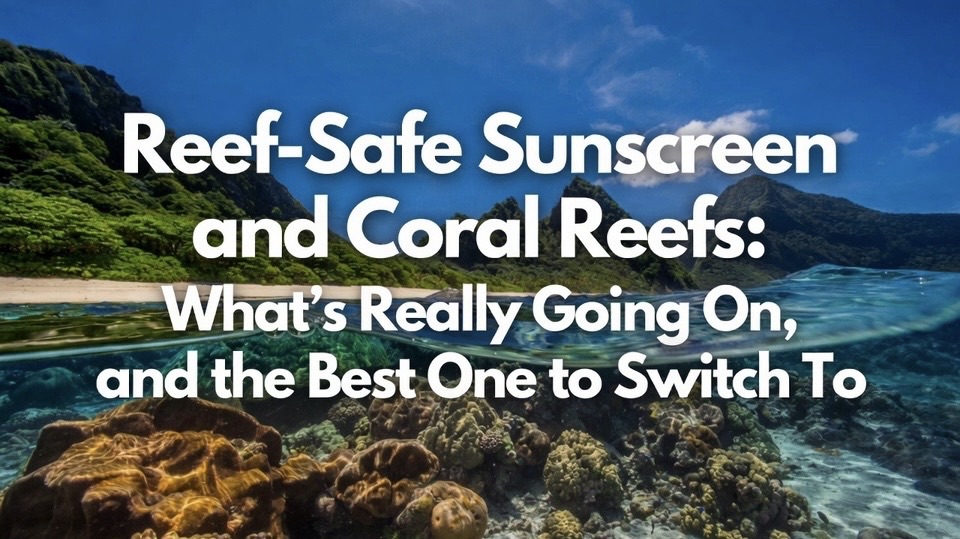
You have probably seen something about sunscreen and coral reefs, in a headline, a friend’s post, or a sign at a beach shop, and wondered what’s actually true and which reef-safe sunscreen you’re supposed to buy instead. Here is the plain-language version from someone who worked on coral reefs for a living, the one product I trust most, and three easy ways to turn sunscreen into something bigger.
This post contains affiliate links. If you buy something through one of them, I earn a small commission at no extra cost to you. As always: before buying anything new, consider whether you already own something that works. When a purchase does make sense, I only link to things I’d actually recommend. Full disclosure policy here.
Table of Contents
I spent part of my career at NOAA’s Coral Reef Conservation Program, the Marine Stewardship Council, and the Environmental Working Group, and the rule I carried out of all three is simple: a product should be safe and effective for the person using it and safe for the world it ends up in. Sunscreen can be one of those sweet spot cases where those are the same product, so nothing here asks you to give anything up. Let’s start with what the concern is really about, because the internet has made it more confusing than it needs to be.

What the sunscreen-and-coral concern is actually about
The short version: a handful of chemicals used in conventional sunscreen are bad news for coral, and they do not stay on your skin.
NOAA’s National Ocean Service summarizes research, some of it led by NOAA scientists and their partners, on how common UV-filter chemicals damage reefs. In one study, the filter oxybenzone proved highly toxic to young, developing coral, with four documented effects: a greater chance of bleaching, DNA damage, deformed skeletal growth, and gross deformities in coral larvae. An earlier NOAA study found that a related chemical, benzophenone-2, could kill juvenile coral at very low concentrations and was not removed by most wastewater treatment.
NOAA is careful to call this an active area of research, and so am I. But the direction of the evidence is clear enough that several places have already acted on it: Hawaii, Key West, and Palau have restricted the sale or use of sunscreens containing certain chemical filters.
The amounts involved are not trivial. Surfrider Foundation, whose work I have supported as a member for years, estimates that roughly 14,000 tons of sunscreen wash into the ocean every year, and that oxybenzone can trigger coral bleaching at concentrations as low as five parts per billion. Water at popular swimming spots has tested far higher than that.
And it is not only the reef that has a stake. The same chemicals absorb through your skin: the CDC has found oxybenzone in the urine of more than 90 percent of the people it tested, the compounds have turned up in the bloodstream, and the FDA has proposed pulling the common chemical UV filters from its “generally recognized as safe and effective” list, citing thin safety data and possible hormone effects. So this is not a niche concern for divers. It is a health-and-water question for anyone who buys sunscreen.

How to spot a genuinely reef-safe sunscreen (ignore the front of the bottle)
Here is the part that cuts through the marketing. “Reef safe” and “reef friendly” are not regulated terms. Any brand can print them on any bottle, even one full of the chemicals above. The only reliable move is to flip the bottle over and read the active ingredients.
Choose a sunscreen whose only active filters are non-nano zinc oxide or titanium dioxide. These are mineral filters. They sit on top of your skin instead of soaking in, they are the two the FDA still treats as safe and effective, and they are the reef-friendlier choice. The “non-nano” part matters: smaller particles are easier for marine life and your own body to absorb, so you want micro-sized or non-nano on the label.
Skip anything listing oxybenzone, octinoxate, octocrylene, avobenzone, homosalate, or octisalate. If a chemical filter is in the ingredients, it is not reef friendly, whatever the front of the package claims.
Surfrider’s free Reef-Friendly Sunscreen Guide lays out the full avoid-list and the science behind it, and it is the single best thing to read before you buy. Save it, and send it to anyone who asks you “wait, is my sunscreen a problem?”
The best reef-safe sunscreen to switch to: Stream2Sea
If you want one answer, this is mine: Stream2Sea
I rate it highest because of the receipts, and it has more of them than any brand I have found. It carries three independent certifications that most “reef safe” products do not: it is EWG Verified (the Environmental Working Group’s strictest health standard, meaning no ingredients of concern and full disclosure), it holds the Protect Land + Sea certification from the Haereticus Environmental Lab, and it is USDA Certified Biobased.

On top of the certifications, the company publishes its own testing instead of asking you to take its word for it. Aquatic-toxicity work run by the EcoTox team at Eckerd College found no fish mortality and normal swimming and feeding behavior next to a competitor product that altered both. Coral-larvae settlement tests showed its SPF 20 and 30 did not significantly reduce larval settlement, while a competitor’s did. Its titanium dioxide is independently verified as non-nano. Stream2Sea was among the first sunscreen makers to earn EWG Verified status, and one of the first to test for safety to coral larvae and fish at all. Every study is posted on their science page if you want to read them yourself.
The honest catch: no sunscreen is zero-impact. Even minerals can be toxic at high enough concentrations, as Surfrider itself notes, and a bottle of the right sunscreen does not undo a warming, acidifying ocean. The greenest sun protection is the kind you don’t have to apply at all: a rash guard, a hat, and shade in the middle of the day. Use those first, then put non-nano mineral sunscreen on whatever skin is left.

One swap, three ways to make it count
This is the part I care about most. A good swap is a starting point, not the finish line. The same fifteen-dollar decision can do three jobs at once: buy smart, speak up, and talk it out. Here is how that works with this one bottle.
1. Make the swap that makes economic sense
You were going to buy sunscreen anyway. A reef-safe mineral sunscreen costs about the same as the chemical kind, so there is no real premium to pay and nothing to give up. What you get back is two forms of value: protection for your own health, and a small bit of protection for an ecosystem that is worth a great deal of money. Healthy reefs underwrite coastal economies through fisheries, storm protection, and tourism. Protecting nature is not a cost you absorb, it is value you keep.
2. Speak up for common-sense protections
Where it is relevant to your life, a beach town you live in or visit, a lake or river you care about, a reef you have snorkeled, the next step is to back the kind of evidence-based, common-sense protections that places like Hawaii, Key West, and Palau have already adopted. It is about clean water, living reefs, and the fishing and tourism jobs that depend on both, which is common ground for almost everyone.
Concretely, that can look like letting a local official, park manager, or dive shop know you support reef-friendly sunscreen education and sensible ingredient standards; backing the groups doing the science and the public education, which for me has meant being a member of Surfrider for years; and passing along that free guide so the next person can decide for themselves. None of it takes much, and protections tend to follow when enough ordinary people make it clear they want them.
3. Talk to the people who trust you
This is multiplier, and the research on it is consistent: the most persuasive messenger on something like this is not an ad or an institution, it is a person you already trust. So tell your people why you switched. Not a lecture, just your reasons. What convinced you. Why you care about a particular stretch of coast, a reef you have seen, or the kind of summer you want the kids in your life to still be able to have.
When you talk about the things you care about, and about why you are concerned for the future of the people and places you love, you give the people who trust you a reason to look, and permission to act. That conversation moves more than any single purchase will. A swap protects one reef’s worth of water. A conversation can start a dozen more.
Frequently asked questions
Is “reef safe” sunscreen actually a regulated label?
No. “Reef safe” and “reef friendly” are unregulated marketing terms, so a product can use them even if it contains chemicals known to harm coral. The reliable way to judge a sunscreen is to read its active ingredients, not the front of the bottle.
Which sunscreen ingredients should I avoid for reefs and marine life?
The common ones flagged by reef-protection groups are oxybenzone, octinoxate, octocrylene, avobenzone, homosalate, and octisalate. If a chemical UV filter is listed as an active ingredient, the product is not reef friendly.
What ingredients should I look for instead?
A reef-friendlier sunscreen uses only non-nano (or micro-sized) zinc oxide or titanium dioxide as its active filters. These are mineral filters that sit on the surface of the skin.
Are mineral sunscreens as effective as chemical ones?
Yes. Non-nano zinc oxide and titanium dioxide provide broad-spectrum UVA and UVB protection. Some leave a slight white cast, which newer sheer or tinted formulas have largely solved.
Does this matter if I never swim in the ocean?
Yes. Sunscreen chemicals wash into lakes, rivers, and waterways through wastewater, and they are not fully removed by treatment. Choosing mineral sunscreen helps freshwater ecosystems too, and reduces what your own body absorbs.
What is the single best reef-safe sunscreen?
The one I trust most is Stream2Sea, because it backs the claim with independent certifications (EWG Verified, Protect Land + Sea, USDA Biobased) and publishes its own coral-larvae and fish-toxicity testing rather than relying on the label.
I already own chemical sunscreen. Should I throw it out?
No. Tossing usable product is its own waste. Use what you have for non-water activities if you like, and switch to mineral sunscreen when it runs out.
The point of all this is not to feel guilty at the beach. It is to notice that a single, ordinary purchase can protect your own health, help protect a place worth protecting, and give you something true to say to the people who trust you. Good choices don’t require sacrifice, and the best ones do several jobs at once.
So pick one thing. Switch the sunscreen, read the label next time, send the guide to a friend, or just tell someone why you care. Any one of those is a start, and starts are what add up.
Disclosure: this post contains affiliate links. Read the full policy here. All products were selected based on independent research. No brand paid for a mention.
Get the next swap before it’s public
I send new vetted swaps, the economics behind them, and the occasional warning about a product that did not earn its hype. No spam, I never sell your address, and you can unsubscribe anytime.


Leave a Reply