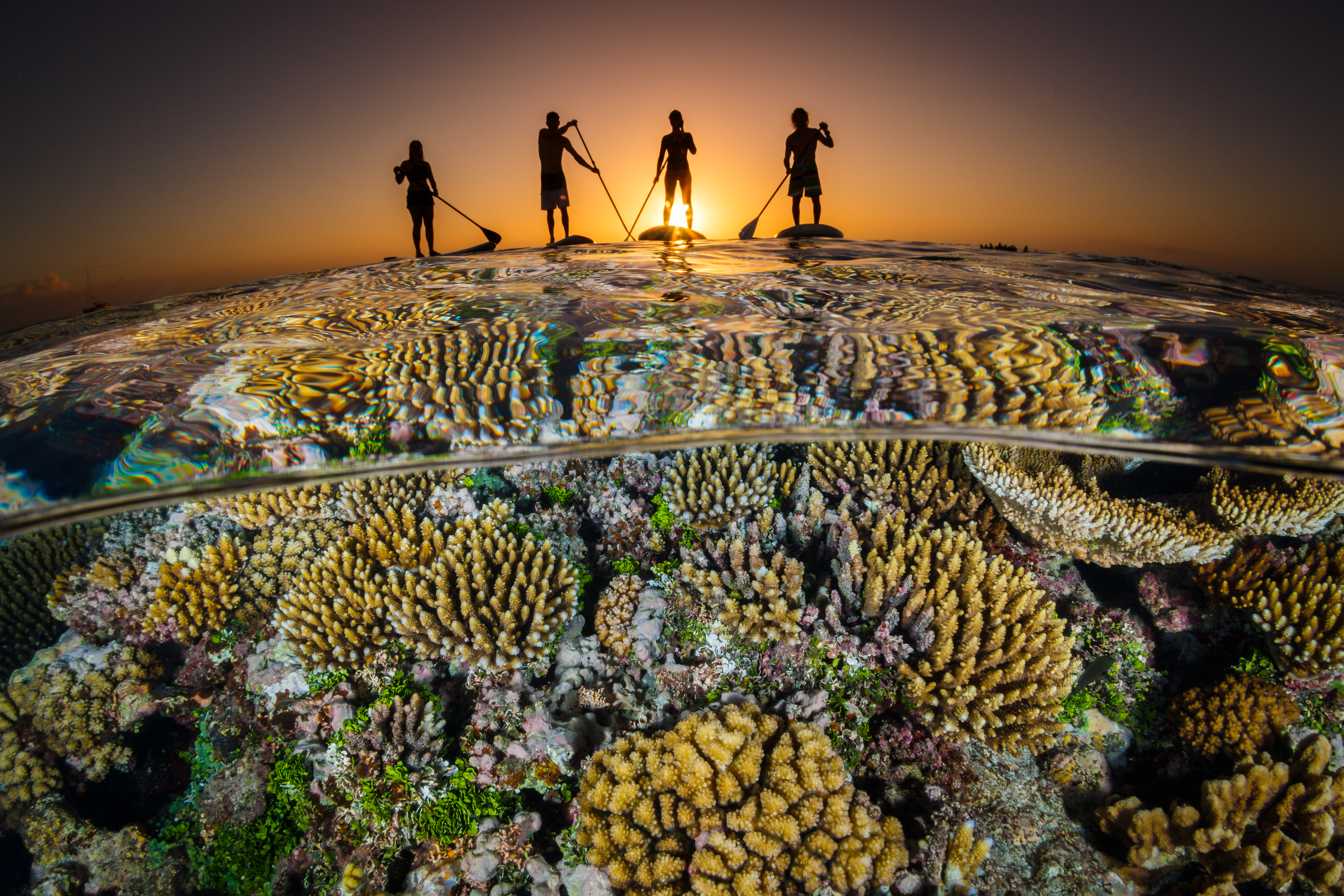
Featured image credit: Grant Thomas / Ocean Image Bank
Where to find beautiful ocean photos and video you can use for free, plus what the research says about getting people to care enough to do something.

June 8 is World Ocean Day, and around this time every year I hear a version of the same worry from friends who care about the ocean but feel stuck. They want to help, but they are not marine biologists or policy experts, and they doubt that a post from one ordinary person changes anything. I understand the hesitation. I also think it is mostly mistaken.

I have spent much of my career working on ocean and coastal issues, starting at NOAA’s Coral Reef Conservation Program and later with organizations like the Marine Stewardship Council and the High Level Panel for a Sustainable Ocean Economy. The thing that has stayed with me is how often the public still treats the ocean as scenery, something lovely to look at on vacation, when in practical terms it behaves more like infrastructure we all depend on. More than half of Earth’s oxygen comes from the ocean, produced by drifting plankton most of us will never see. In the United States, the ocean economy generates roughly $282 billion in goods and services and supports close to three million jobs. Counted on its own, the ocean’s output would rank as the seventh largest economy in the world. Protecting the ocean is, among other things, protecting a working economy that a great many people rely on for their living.
What follows is the toolkit I wish I could hand those friends. The first half is a directory of places to find beautiful ocean photos and video you can use at no cost. The second half is a plain summary of what behavioral researchers have actually learned about persuading people to act, some of it specific to marine conservation and much of it from the wider science of behavior change. There is a short walk-through near the end for building your own post, and a complete source list so you can check any claim here for yourself.

Where to find ocean imagery you can use for free
You do not need a camera or a stock-photo budget to illustrate an ocean post well. A surprising amount of excellent material has been made free, much of it specifically so that people can use it to talk about the ocean. A few ground rules before the list. Always read the license attached to the specific file you download, since terms differ from one library to the next and sometimes from one photo to the next. Credit the photographer whenever the license asks you to, which is good manners even when it is not strictly required. And never present an image in a way that suggests a photographer or agency endorses you or your cause without their permission.
Two collections were built for this exact purpose:
- Ocean Image Bank (The Ocean Agency). Thousands of professional ocean photographs and videos, contributed by more than 200 photographers and made free in support of ocean science, conservation, and education. It is organized by subject, including coral reefs, kelp forests, sharks, mangroves, and seagrass, and it is an endorsed project of the UN Ocean Decade. Credit the photographer in the format listed on each image.
- Open Planet. A growing library of cinematic environmental footage, free for educational, environmental, and impact storytelling. Its Storytelling for Ocean Recovery collection draws on the production team behind the film Ocean with David Attenborough. The footage is intended for non-commercial use, so confirm your project fits before downloading.
Public collections from governments and museums are another deep well, and most of their still images are in the public domain:
- NOAA Photo Library. Around 70,000 public-domain images covering marine species, coastlines, and the national marine sanctuaries. NOAA asks that you credit the agency and the photographer. The public-domain status applies to the photos; some videos in NOAA’s collections include third-party footage, so check those individually. The National Ocean Service gallery is a good companion.
- Smithsonian Open Access. Nearly three million images released under a Creative Commons Zero (CC0) designation, meaning you can use them for almost anything, commercial or not, without asking permission. For ocean material and reliable facts, the Smithsonian Ocean Portal is a good starting point.
- NASA Image and Video Library. Public-domain satellite views of the ocean and coastlines, useful when you want to show scale, currents, or change over time.
- U.S. Fish and Wildlife Service National Digital Library. Public-domain photography of coastal habitats and wildlife.
For broad, fast searches, the general free-stock sites are hard to beat:
- Unsplash, Pexels, and Pixabay all offer high-resolution photos, and Pexels and Pixabay also carry 4K video. Use is free and attribution is generally not required. Pixabay does ask that you not resell files as they are or use images that contain recognizable trademarks.
- Coverr and Mixkit specialize in free video clips with no watermark, cleared for commercial use.
Finally, two enormous pools where licensing varies file by file, so read carefully before you download:
- Wikimedia Commons and Flickr Commons, along with Flickr’s Creative Commons search. Both hold a mix of public-domain and Creative Commons material. Many files are free to use with attribution. Check the license on each item and follow its terms.

What the research says about getting people to act
Sharing a beautiful photo is a fine start, but if the goal is to move people toward advocacy, it helps to know what tends to work. A fair amount of research now exists, some of it specific to marine conservation and much of it from the broader study of behavior change. The findings are not magic, and human behavior is stubborn, but a few patterns come up often enough to be worth trusting.
Hope tends to work better than fear, when it is honest
When an issue is serious, the instinct is to frighten people into caring. It rarely works for long. Fear can prompt a quick, narrow reaction, but as a steady message it pushes people toward avoidance and despair rather than engagement. That was part of the thinking behind Ocean Optimism, the movement the marine scientist Nancy Knowlton helped start in 2014 to circulate stories of marine recovery alongside the more familiar stories of loss. The Rise of Ocean Optimism in Hakai Magazine tells that origin story well.
The balance matters, though, and the honest version is more interesting than the slogan. In her review Ocean Optimism: Moving Beyond the Obituaries in Marine Conservation, Knowlton notes that relentless positivity can breed complacency, while constant doom produces hopelessness, and that negative information tends to stick in memory more easily than good news. Leaving an audience with genuine hope therefore takes some deliberate effort. A real-world test of this came after a 2019 study documented the loss of three billion birds across North America. The conservation campaign that followed paired that sobering number with hopeful, specific actions people could take, rather than the loss alone. Other experimental work has found that optimistic environmental messaging can increase real, observed pro-environmental behavior, not only stated intentions. The practical lesson I take from all of it is to be honest about a problem, and then offer both a credible way forward and one concrete thing a person can do about it.

Show that things are changing, not only that they matter
One of the more useful findings for advocates comes from research on what psychologists call dynamic norms. People are influenced by what others around them are doing, which is familiar enough. Less obvious is that we are moved even more by behavior that is visibly changing. In a set of experiments by Gregg Sparkman and Gregory Walton at Stanford, telling people that a growing number of others were starting to do something prompted more change than telling them it was already common, even when the behavior still ran against the current majority. In one field study, a message built around change cut water use during a drought by close to 30 percent, against about 10 percent for a conventional message. The researchers describe the effect partly as preconformity, a sense that because others are shifting, the behavior is becoming important and worth adopting early.
For ocean advocacy this is encouraging, because there is real movement to point to. As of April 2026, just over 10 percent of the ocean is now officially designated as protected, up from 8.6 percent two years earlier and equal to about a third of the international goal of protecting 30 percent of the ocean by 2030. The UN High Seas Treaty entered into force in January 2026, the first global agreement aimed at protecting marine life in international waters. Individual countries keep adding to the total. France created the world’s largest marine protected area around French Polynesia in 2025, and Ghana declared its first marine protected area after more than fifteen years of effort. Showing that protection is expanding, with specifics, is more persuasive than insisting in the abstract that the ocean matters.
I would add one note of honesty here, partly because it is the kind of thing my readers care about and partly because it keeps our credibility intact. Designating an area as protected is not the same as protecting it well. By the stricter accounting of the Marine Protection Atlas, only around 3.3 percent of the ocean is fully or highly protected, with the rest ranging from lightly managed to barely managed at all, and some designated areas in Europe still permit bottom trawling. So the 10 percent milestone is worth celebrating and worth qualifying in the same breath. In my experience, saying so openly builds more trust than glossing over it.

Connect the ocean to what people already care about
How an issue is framed changes who is willing to listen. A large body of communication research finds that presenting environmental action as an opportunity, tied to things people already value like jobs, health, and a stable local economy, draws broader support than presenting it mainly as a sacrifice or a distant threat. The World Economic Forum recently summarized the shift in climate storytelling from fear toward agency and tangible benefits. Health framing has a particularly useful feature. Because people across the political spectrum care about their families’ health, framing environmental harm and its solutions in health terms tends to raise engagement and support even among people who are otherwise skeptical. A 2026 systematic review in Annals of Behavioral Medicine went further, finding that health-framed messages can outperform both environmental and economic frames, especially when the risk feels personally close. Reviews of the co-benefits of climate action, from cleaner air to new employment, point in the same direction.
This is close to the reason I started writing about the ocean through an economic lens in the first place. When a coastal community sees that a healthy reef or a well-managed fishery also supports local jobs and tourism income, and helps keep food on the table, protection stops being an abstract environmental nicety and becomes a matter of self-interest, in the good sense of that word. Tie the ocean to a person’s livelihood and their dinner plate, and the conversation tends to change.

Lead with something beautiful
There is a reason the imagery comes first in this toolkit. It is tempting to treat a beautiful ocean photo as decoration, but the research suggests it does more than that. Researchers who study awe, the feeling of encountering something vast and wondrous, have found that positive awe increases people’s sense of connection to nature, and that this connection in turn predicts whether they act to protect it. More recent work traces the same path from awe to environmental action. It is part of why a film like Ocean with David Attenborough affects people the way it does. An image that makes someone stop and feel something leaves them far more receptive to the facts and the request that follow. So when you build a post, start with the photograph or clip that makes a person pause, and let the message come after.

Making your own World Ocean Day post
If you want to put this into practice today, here is the approach I would use. None of it requires special tools or expertise.
- Start with an image that stops the scroll. Choose a genuinely beautiful ocean photo or short clip from one of the libraries above, and credit the photographer if the license asks. The awe research suggests this is what earns a person’s attention in the first place.
- Add a single, specific fact. One is plenty. A precise figure, such as the ocean producing more than half of our oxygen, or 10 percent of the sea now being protected, lodges in memory better than a sweeping statement about the ocean being in trouble.
- Show that progress is possible. Pair the fact with a recent sign of movement, so the post leaves people feeling that effort pays off rather than that the situation is hopeless.
- Make it relevant to your audience. Connect the issue to something the people you are talking to already value, whether that is the coastline they grew up near or the local livelihoods that depend on a healthy sea.
- Ask for one clear action, and post it. Give people a single doable next step with one link, rather than a long list of demands, and then publish it on whatever platforms you use.
The case for speaking up
Coming back to those friends from the start. The ocean does not need every advocate to be a scientist. It needs more people willing to talk about it honestly and often, in their own voice, to the people who already trust them. The research on persuasion is genuinely encouraging on this point, because the things that work, like honesty, a sense of momentum, relevance to people’s lives, and a beautiful image to draw them in, are all within reach of anyone with a phone and a few spare minutes.
So this World Ocean Day, pick one thing about the ocean that you care about, and say something about it in your own words. That is how most of us who do this work got started.

Sources and references
Ocean facts and the ocean economy
- How much oxygen comes from the ocean?, NOAA National Ocean Service
- Ocean economy goods, services, and employment, NOAA National Ocean Service
- World must act faster to protect 30% of the planet by 2030, UN Environment Programme (ocean as seventh-largest economy)
- World reaches milestone for nature: 10% of ocean now officially protected, IUCN and UNEP-WCMC, 1 April 2026
- World Oceans Day: Marine protected areas surpass 10% mark in 2026, Mongabay
- 10% of the ocean is protected. Now just 20% more to go, Mongabay (fully and highly protected figure)
- Marine Protection Atlas, Marine Conservation Institute
- Marine Protected and Conserved Areas, Protected Planet (High Seas Treaty entry into force)
Research on motivation and messaging
- Knowlton, N. (2021), Ocean Optimism: Moving Beyond the Obituaries in Marine Conservation, Annual Review of Marine Science
- Kelsey, E., The Rise of Ocean Optimism, Hakai Magazine
- Promoting Conservation Behaviors by Leveraging Optimistic and Pessimistic Messages and Emotions (2023), Society and Natural Resources
- MacKinnon, Davis and Arnocky (2022), Optimistic Environmental Messaging Increases State Optimism and in vivo Pro-environmental Behavior, Frontiers in Psychology
- Sparkman, G. and Walton, G. (2017), Dynamic Norms Promote Sustainable Behavior, Even if It Is Counternormative, Psychological Science
- Dynamic norms research summary, National Social Norms Center
- World Economic Forum (2026), Why we must move climate storytelling from fear to agency
- Effective Advocacy and Communication Strategies at the Intersection of Climate Change and Health, George Mason University Center for Climate Change Communication
- Communicating the health implications of global environmental change (2026), Annals of Behavioral Medicine
- Mapping the co-benefits of climate change action (2020), The Lancet Planetary Health
- Influence of Positive and Threatening Awe on Pro-Environmental Behavior: The Mediating Role of Connection to Nature (2025)
- Awe and adolescents’ pro-environmental behavior: the role of nature connectedness and moral identity (2025), Journal of Environmental Psychology
Free image and video libraries
- Ocean Image Bank, The Ocean Agency
- Open Planet
- NOAA Photo Library
- NOAA National Ocean Service image gallery
- Smithsonian Open Access
- Smithsonian Ocean Portal
- NASA Image and Video Library
- U.S. Fish and Wildlife Service National Digital Library
- Unsplash
- Pexels
- Pixabay
- Coverr
- Mixkit
- Wikimedia Commons
- Flickr Commons
Get the next swap before it’s public
I send new vetted swaps, the economics behind them, and the occasional warning about a product that did not earn its hype. No spam, I never sell your address, and you can unsubscribe anytime.


Leave a Reply