This post contains affiliate links. If you buy something through one of them, I earn a small commission at no extra cost to you. As always: before buying anything new, consider whether you already own something that works, or whether you can find it secondhand. When a purchase does make sense, I only link to things I’d actually recommend. Full disclosure policy here.
Let me tell you something that a surprising number of people who followed yesterday’s DIY solar post don’t know yet.
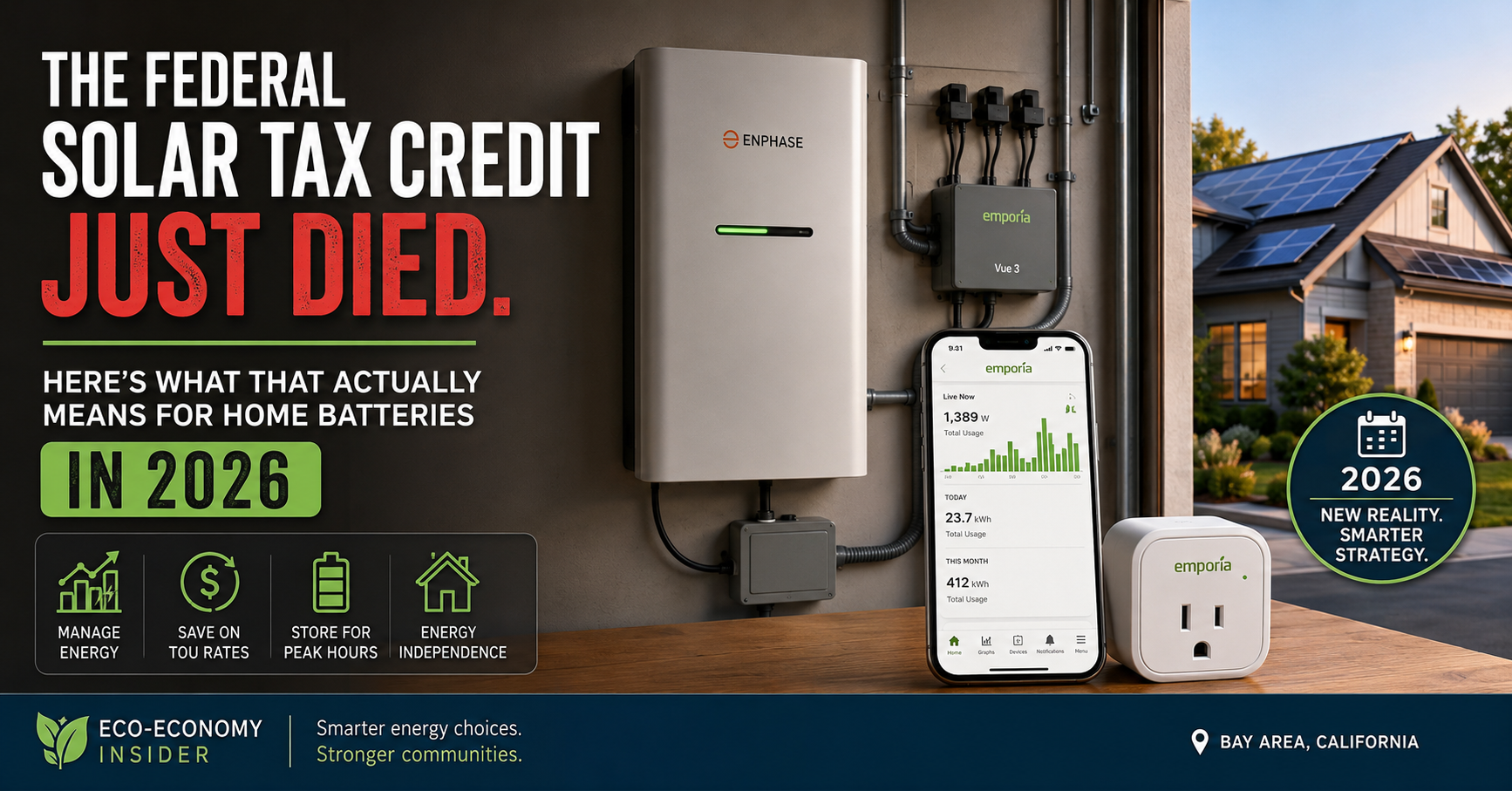
The 30% Residential Clean Energy Credit (the federal tax incentive that covered solar panels, batteries, and installation costs) was killed for any residential system placed in service after December 31, 2025. The One Big Beautiful Bill accelerated a timeline that was supposed to phase down gradually through 2034 and ended it outright instead.
If you installed your system in 2025, you’re fine. Claim it on your 2025 return using IRS Form 5695.
If you’re thinking about it now, in 2026, the federal credit is gone for cash or loan purchases. That’s the reality. Worth knowing before you get a quote.
Here’s what I want to talk about next, though: why I think this changes the math less than you’d expect — and why the smarter starting point for most people isn’t a battery at all. It’s a twenty-dollar smart plug.
The incentive left. The economics stayed.
Battery prices have dropped roughly 40% since 2020. Payback periods that used to stretch to 15 years have compressed to 6 to 10 years in markets with high electricity rates — and that’s without a federal credit. Batteries are a big reason solar and storage made up 81% of new U.S. generating capacity in 2024.
The technology got cheaper at almost exactly the rate the subsidy disappeared. That’s not a coincidence — it’s what happens when manufacturing scales and competition increases. Battery pack costs are now $108 per kilowatt-hour and declining another 3% in 2026, reaching a level at which it’s cost-effective to store enough power for one to two full days of backup, not just an hour or two. Pairing storage with plug-in solar that works for renters and homeowners stretches the savings even further.
Meanwhile the other side of the equation — what you’re paying for electricity — keeps moving against you. PG&E customers faced a major bill restructuring starting March 2026 with the introduction of a fixed Base Services Charge of roughly $24 per month, alongside changes to the per-kilowatt-hour usage rate. And that’s on top of years of rate increases driven by wildfire mitigation, grid modernization, and EV infrastructure buildout.
So the credit is gone, but the case for home energy management is stronger than it’s ever been. The question is where to start.
For Bay Area residents specifically: here’s the PG&E picture
This is worth understanding before you spend anything, because the savings math depends entirely on the gap between your peak and off-peak rates.
On PG&E’s standard residential TOU plan (E-TOU-C), peak hours run from 4 p.m. to 9 p.m. every day. Off-peak is midnight to 3 p.m. — 15 hours per day. There’s also a partial-peak period from 3 to 4 p.m. and 9 p.m. to midnight.
The rate difference between peak and off-peak is not just a few cents — it’s a significant multiplier. Run your dishwasher during off-peak hours and you might pay $0.52 for that cycle. Run it during peak hours and the same cycle costs substantially more.
California’s peak hours shifted to later in the day specifically because of the massive increase in solar power during midday hours — the grid has abundant cheap power during the day and expensive, strained power in the early evening when the sun goes down and everyone comes home.
This is the fundamental dynamic that makes home energy management worth thinking about seriously in the Bay Area. If you can shift your heavy loads — dishwasher, laundry, EV charging, water heating — out of that 4 to 9 p.m. window, you save real money without spending anything. A battery or a set of smart plugs just automates and deepens what you could already start doing manually today.
The hierarchy: what to actually do, in order
Step one, and it’s free: shift your habits.
Run the dishwasher after 9 p.m. Do laundry before 3 p.m. Pre-cool your house before peak hours start. Charge your EV overnight. PG&E customers who’ve done this report it requires almost no sacrifice — “really no sacrifice at all” is the direct quote from one customer who shifted laundry to mornings and set her dishwasher to run after 9 p.m. This costs nothing and takes one afternoon to set up.
Step two, and it’s around $20: find out what’s actually using your power.
Before you spend $15,000 on a battery system, you should know which appliances are responsible for your bill. Most people don’t. A failing refrigerator, an old water heater, or a gaming console in standby can each account for 15 to 25% of total household consumption. Home energy monitors decrease your electricity bill by an average of 15% within 2 to 4 months of installation. The payback on a $20 monitoring plug is measured in weeks, not years.
Step three: automate the shift with smart plugs.
Once you know which devices are the biggest drains, automate them. Set a smart plug to cut power to your entertainment center at 4 p.m. and restore it at 9 p.m. Schedule your coffee maker to run at 6 a.m. instead of sitting in standby all day. This is low-cost, reversible, and works in a rental the same as in a house you own.
Step four: consider a whole-home monitor if you have solar or an EV.
If you’re generating solar power or charging an EV, a panel-level monitor gives you real-time data on when you’re producing vs. consuming vs. exporting to the grid. Under NEM 3.0 in California, export compensation is a fraction of what it used to be — which means the value of using your own solar power at home rather than sending it to the grid has increased dramatically. A monitor tells you exactly when to run your big loads.
Step five: batteries, when the math works for you specifically.
In high-rate TOU markets, a home battery alone — no solar panels required — can save $900 to $1,200 per year by charging from the grid during cheap overnight hours and discharging during expensive peak hours. A typical 13.5 kWh home battery system costs around $15,228 before incentives in 2026. Do that math against your specific utility rates and usage patterns before committing. For some households it pencils. For others, steps one through four deliver 80% of the benefit at 2% of the cost.
Products worth considering — in the order you’d actually use them
I’m recommending these because I’m buying them myself. The eco-economy case for all of them is the same: using energy more intelligently reduces demand on the grid during peak hours, which is exactly when the most expensive and often dirtiest peaker plants run. Efficiency is climate action.

Kill A Watt EZ P4460 electricity usage monitor
The simplest starting point. Plug it between the wall and any appliance, and it shows you real-time wattage, cumulative kilowatt-hours, and estimated monthly cost. No Wi-Fi, no app, no subscription. Just honest data about what your appliances actually cost to run. Start with your refrigerator, your TV, and whatever you leave in standby. You will find something surprising within the first hour.

TP-Link 𝗧𝗮𝗽𝗼 Smart Plugs
TP-Link Tapo P115 smart plugs (4-pack)
The best-reviewed product in its category — over 3,100 ratings averaging 4.6 stars. Real-time monitoring, detailed consumption statistics, bill estimation, and a Charge Guard feature that cuts power when a device battery is full, preventing the subtle degradation caused by continuous trickle charging. The mini form factor doesn’t block adjacent sockets. Buy the 4-pack for best per-unit value, put them on your four biggest suspected energy hogs.

Vampire power — the electricity devices draw in standby — can account for up to 10% of your household bill. A smart power strip with individually switchable outlets lets you cut power completely to your entertainment center, home office equipment, or charging station on a schedule, without needing a separate plug on every device. Look for one with energy monitoring built in.

Emporia Vue 3 whole-home energy monitor
The best overall home energy monitor for most homeowners in 2026. Starts at $99, scales with your needs, supports solar monitoring, has no subscription fees, and works with the Emporia smart EV charger to optimize charging around TOU rates or excess solar production. Installs at your electrical panel — two current sensors on the mains plus up to 16 sensors on individual circuits. If you have solar panels or an EV, this is the one to get. Note: installation requires opening your electrical panel. Comfortable with that? DIY it. Not comfortable? An electrician charges $100 to $150 for installation, which still makes the math work.

Ecobee smart thermostat premium
Your HVAC system is typically 40 to 50% of your electricity bill. A smart thermostat that understands TOU pricing is the highest-leverage single purchase most households can make. The Ecobee lets you pre-cool your home before 4 p.m., hold a higher temperature during peak hours, and restore comfort after 9 p.m. — automatically, every day, without thinking about it. Works with PG&E’s SmartRate program if you enroll. Alexa built in.
The honest bottom line
The federal credit is gone. That’s a real loss and worth being direct about. But the underlying case for home energy management — understanding what you use, shifting when you use it, and reducing dependence on expensive peak-hour grid power — has not changed. If anything, with NEM 3.0 reducing solar export compensation and PG&E’s new rate structure making the peak/off-peak price difference more consequential, the value of using energy intelligently has gone up, not down.
Start with the Kill A Watt. Find out what’s actually running in your house. Then work up the ladder at whatever pace makes sense for your budget and your situation.
The goal isn’t a perfect home energy system. It’s a home that wastes less, costs less to run, and draws less from the grid when the grid is most strained. You can make meaningful progress on all three of those things before you spend a dollar on a battery.
Disclosure: this post contains affiliate links. Read the full policy here. All products were selected based on independent research — no brand paid for a mention.
Get the next swap before it’s public
I send new vetted swaps, the economics behind them, and the occasional warning about a product that did not earn its hype. No spam, I never sell your address, and you can unsubscribe anytime.


Leave a Reply